
Food history
UNESCO Loves Italian Food. So Does Kissimmee's Red-Sauce Table
UNESCO put Italian cooking on its heritage list in December 2025. Here's how lasagna, chicken parm and vodka sauce carry that story to Kissimmee.
By The New York Pizza Company6 min read
This week, a committee meeting in New Delhi made a lot of Italian grandmothers feel very, very right. On December 10, 2025, UNESCO added Italian cooking to its list of the intangible cultural heritage of humanity. That's the list for living traditions, the things people do and pass down, as opposed to the better-known World Heritage list of old buildings and ruins.
Italy's prime minister, Giorgia Meloni, celebrated the decision as a world first, and the news ran everywhere. Here in Kissimmee, at a pizzeria with a New York skyline painted on the wall, we read it and started wondering where we fit in.
A red-sauce kitchen in Florida fits in better than you'd think. The dinners on our menu are Italian-American, a way of cooking that started in Italian kitchens, crossed an ocean, and picked up a few new habits on the way.
What UNESCO recognized in Italian cooking
The official name of the listing is a mouthful: "Italian cooking, between sustainability and biocultural diversity." There's no carbonara clause in it and no special mention of pizza, because it doesn't single out any dish. UNESCO's description is about how Italians cook and eat. It covers working with raw ingredients and making food by hand, recipes built around wasting nothing, and cooking as a way to take care of yourself and the people around you.
Most of all, it's about passing things down. UNESCO notes that grandparents often teach the traditional dishes to their grandchildren, and that the know-how moves through families at home as well as through schools and universities. News reports boiled it down to the big Sunday lunch and kids learning from their grandmothers how to fold tortellini.
One line in the committee's decision caught our eye. It mentions the people who helped put Italy's application together, practitioners living "anywhere in Italy and around the world." Around the world covers a lot of ground, and we like to think it includes a few million Italian-American kitchens.
France got a similar honor back in 2010 for the gastronomic meal of the French. Italy's leaders say theirs is the first listing to cover a whole national cuisine, and they weren't shy about saying it.
How Italian food changed when it came to America
Between 1880 and 1920, more than 4 million Italians came to the United States, according to the Library of Congress. A large share of them came from the south of Italy. They carried their recipes with them, but they cooked those recipes with American groceries and American paychecks.
That changed the food. Ian MacAllen, who wrote a whole book on the subject called Red Sauce: How Italian Food Became American, has pointed out that immigrants could suddenly buy meat they couldn't afford back home. So the meat went in and the cheese went on thicker, and the meatballs landed on top of the spaghetti and stayed there.
MacAllen sees red-sauce cooking as its own cuisine, built in America by Italian families. The title of his interview with The Rumpus sums up his view: "If you eat it, it becomes authentic." We'd put that on a T-shirt.
So when people argue about whether chicken parm is "real" Italian food, we tell them it's real Italian-American food. It came from the same instinct UNESCO just praised: cook with what you have, and make enough for the cousins who show up unannounced.
Lasagna, baked ziti and the big baked pan
In Naples, lasagna is a party dish. Italy Magazine describes the Carnival version eaten there before Lent, with sheets of fresh egg pasta layered with a slow-cooked pork ragù, tiny meatballs, ricotta mixed with sauce, and grated cheese. If that reminds you of the lasagna at an Italian-American holiday dinner, you can see the family resemblance.
Italian-Americans kept the big pan and brought it to every celebration they had. MacAllen has mentioned that plenty of Italian-American families serve lasagna right next to the turkey at Thanksgiving. Nobody at those tables thinks that's strange, and most of them think it's the best part.
Baked ziti grew from the same idea. The tube pasta goes in a pan with sauce and cheese and bakes until the edges get a little crispy, and then everyone fights over the corner pieces. It's the dish people bring to a new neighbor, a funeral, a graduation, or a Tuesday.
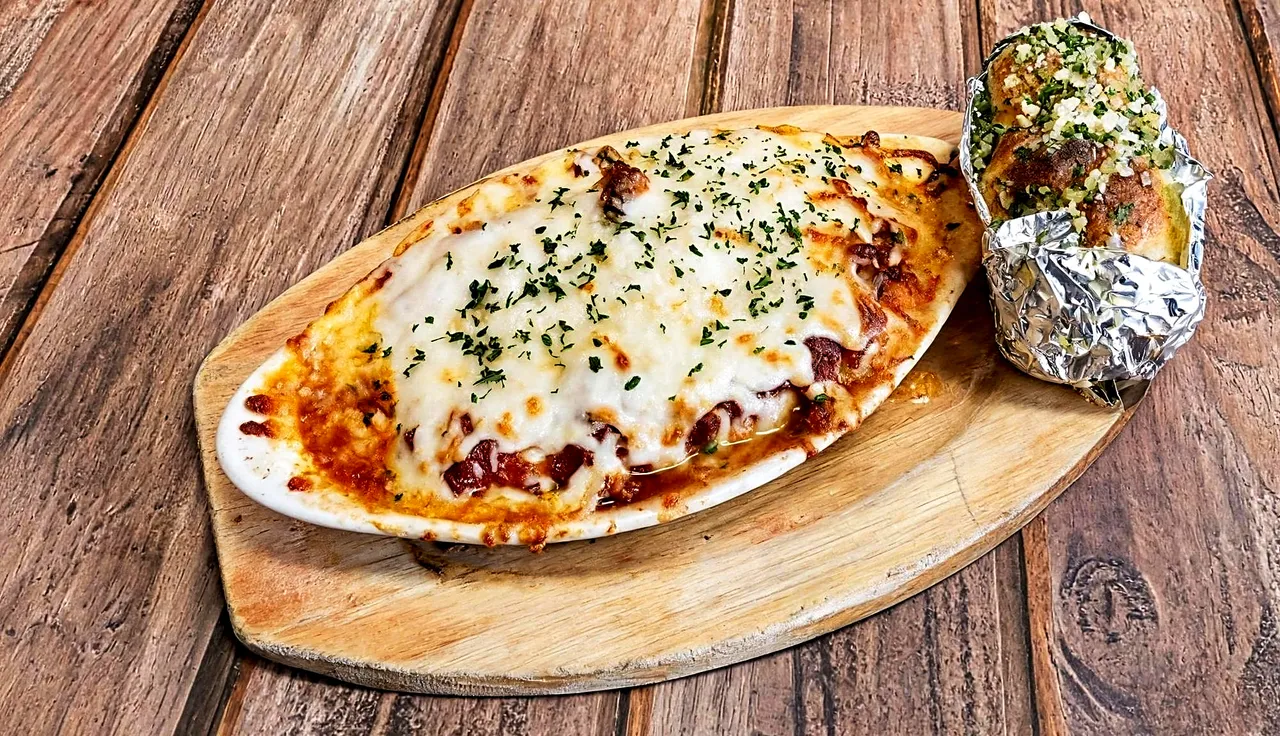
On our dinner menu you'll find Lasagna w/ Meat Sauce and Baked Ziti w/ Marinara, plus Manicotti w/ Marinara and Stuffed Shells w/ Marinara for anyone who likes their pasta filled. Every dinner comes with 2 garlic knots, because a plate of red sauce needs something to wipe it up with.
The parm family: eggplant, chicken and the sub
In Italy, parmigiana usually means eggplant, with fried slices layered with tomato sauce and cheese. Chicken parmesan is the American branch of the family. It grew up among Italian immigrants in the northeastern United States, and by the 1950s it was a staple in Italian-American restaurants. A 1953 recipe in the New York Herald Tribune even told home cooks to use frozen fried chicken, which shows how fast it caught on. Then somebody put it on a roll.
Our menu covers both sides of the family tree. Eggplant Parmesan over Spaghetti Marinara is the older idea, and Chicken Parmesan over Spaghetti Marinara is the American one. On the sandwich side there's the Meatball Parm Sub, the Chicken Cutlet Parm Sub, the Sausage Parm Sub, and the Eggplant Parm Sub.
For people who refuse to choose, "The Big Meaty Chick" puts half meatball parm and half chicken parm on one sub. If someone at your table always wants a bite of everybody else's, order them that one.
Vodka sauce, the youngest dish at the table
Penne alla vodka is a baby by Italian standards, and food historians still argue about who made it first. One story points to a restaurant in Bologna. Another belongs to a chef at a New York restaurant who says he came up with it in the 1970s by cooking vodka into a tomato sauce. The earliest printed recipe anyone has found is in a 1974 Italian cookbook by the actor Ugo Tognazzi. By the early 1980s it was popular in America, often as a late-night plate after the disco. The pink, creamy sauce has been on Italian-American menus ever since.
Ian MacAllen has said his favorite unusual pizza slice is a penne alla vodka slice. That one isn't on our menu, but the sauce shows up three ways: Penne alla Vodka, Crispy Chicken Penne alla Vodka, and Cheese Tortellini alla Vodka. The tortellini version is a nice pick for kids who like cheese and aren't sure about red sauce yet.
Where a family pizzeria in Kissimmee fits in
UNESCO's description keeps coming back to one picture, people sitting down together over food somebody made with care. In Italy that's a family dinner table, and it's also a red booth on a Friday night in Kissimmee, with a pizza in the middle and three kinds of pasta getting passed around.
We're a family-owned New York-style pizzeria in the Walmart Plaza on Osceola Parkway, with a brick wall and the city skyline painted on the wall. Italian-American food came up through neighborhood spots like ours, where you could get a slice at the counter or sit down to a plate of chicken parm. The same families came back to those places week after week. If you're looking for Italian food in Kissimmee that tastes like that tradition, our page Classic Italian Food, Close to Home has more on our pasta dinners and parm.
How to order a red-sauce feast for the family
Here's how we'd build an Italian-American Sunday-style spread from our menu, whatever day it happens to be.
Start with bread. Every dinner already includes 2 garlic knots, but a big group will want an extra order of Garlic Knots (6), which come with marinara.
Pick one baked dish and one parm. Lasagna and Chicken Parmesan side by side is a classic combination, and you can split them down the middle so everyone gets both.
Make it heartier. You can add a Crispy Chicken Cutlet to any dinner for $4.50, or Grilled Chicken Breast for $3.99.
Save room for dessert. Cannoli and Tiramisu are both on the menu, and Zeppole come six to an order for sharing.
You can order online for pickup or delivery, or call us at (407) 933-8800. We're open from 11 a.m. Monday through Saturday and from noon on Sunday, until 8:30 p.m. most nights and 9:30 p.m. on Fridays and Saturdays. We're happy to set the table.